Am I a Slow Reader? (Yes, and It's Probably Fine)
Most adults read at 200–250 WPM. If you're slower, you're not broken. Here's why slow reading is often the better reading.
 Lucas Bewersdorff
Related reading
How to Annotate Nonfiction Books
Annotate nonfiction by marking its argument instead of its best sentences: a mark legend for claims, evidence, and turns. Also: an outline and an index.
The Gothic Classics Starter Pack
Eight gothic classics in reading order, easiest first, with word counts, reading times at two paces, and notes for which you can download for free.
Horror Books for People Who Hate Horror
Eight books that run on dread instead of gore, with notes on each about violence, animal harm, body horror, and cruelty, so nothing ambushes you.
The First Time I Tested My Speed, It Stung
I've written about that first random online speed test before (the full version of that moment is over here), where the angle was that online speed tests are mostly unreliable. This article is about the other half of that same moment, the part I skipped past the first time: the small flinch when the number came back. Below 0.5 pages per minute. The result page told me, in big friendly text, that I was a slow reader. I closed the tab faster than I'd read the test.
What stung wasn't really the number. It was the quiet implication underneath it – that "reading," as a thing, was supposed to mean reading fast. The cultural picture of a real reader is someone who blows through a novel on a Saturday and is starting the next one by Sunday. Below 0.5 PPM doesn't fit that picture, and for a long second I assumed I didn't fit it either. Every slow reader has had some version of that flinch. The articles I'm writing now are partly written for the version of me who closed that tab.
What "Slow" Actually Means
The data is much gentler than the cultural picture. The most-cited number comes from a 2019 meta-analysis by Marc Brysbaert: the average adult reads about 238 words per minute when reading silently, roughly one page every 60–70 seconds. Anything between about 150 and 300 WPM sits inside the broad normal range. Above that, you're usually looking at trained academic readers or people who are trading comprehension for throughput. Below 150 is technically "slow" by the literature – but "below 150" is still real reading, performed by real readers. For the full table of reader types, check out how fast do you read, and for the metric side – PPM vs WPM, why they're not interchangeable – take a look at PPM vs WPM explained.
About half of all readers are, by definition, below average. That's just how averages work. "Slow" means you're sitting in the lower half of a wide normal distribution, which is statistically where half of everyone you know also sits. The 600-WPM "speed reader" your timeline keeps showing you is an outlier, and not in the way they're selling it. Their comprehension is usually worse than yours.
Your speed also moves with what you're reading, the format, and (this one matters more than people admit) the language you're reading in. I'm a native German speaker reading almost exclusively in English. My partner is a native English speaker reading in English. Her average reading speed (tracked by ReadingHabit) sits at about 0.99 PPM, mine at about 0.67 PPM – a real gap, and also a completely meaningless one, because comparing a non-native to a native reader is comparing two different tasks. Zero envy towards her on my end. The variables are different. If your variables are different from someone else's, your numbers should be too.
Get your actual number in under 3 minutes
The free Reading Speed Test gives you WPM, PPM, and a comprehension score – so you can stop guessing where you actually sit.
Take the free speed testSlow Reading Is Usually Better Reading
There are three honest reasons to like being a slow reader, and I've come around to all three.
The first is the trade-off the speed-reading industry mostly doesn't mention: comprehension starts dropping above ~400 WPM. You're not getting a free upgrade by reading faster; you're trading away the part of the read you actually care about. The classic research on this is unambiguous – speed and understanding are not independent variables. Past a certain point, you can have more of one or more of the other, not both.
The second is retention. Reading at the pace your brain can subvocalize is what makes ideas stick. The inner voice is part of how the brain encodes language. Trying to read without it (the standard speed-reading prescription) is trying to read with the encoder turned off. The deeper version of why retention matters, and the techniques that compound it, is in how to actually absorb what you read.
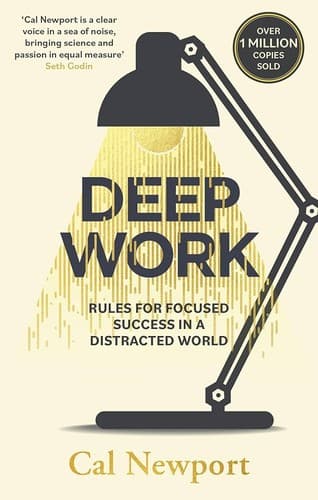
The third is what gets called deep reading: holding characters and arguments in working memory, sitting with an idea long enough to disagree with it, building connections between what you're reading now and everything you've already read. Slow readers do this almost by default. Fast readers have to work at it. The book that landed this for me hardest was Cal Newport's Deep Work. ReadingHabit logged my average on that one at 0.4 pages per minute (noticeably slower than my usual 0.67) across 15 reading sessions. There's a small structural irony in reading a book about focused, high-effort work very slowly. There's also a result: I can still pull up Newport's four-rule framework, two years later, in conversation. That's the difference between "I read that" and "I think with that", and slow reading is what did the work.
Deep Work
by Cal Newport
Newport's case for focused, undistracted work as the highest-leverage skill of the decade. I read it across 15 sessions at 0.4 PPM (the slowest book in my dashboard) and it's the one whose framework I still actually use.
Est. read: 5h 10 min
Get your reading estimateThe Real Variable Isn't Speed – It's Consistency
Here's the math that closed it for me. At my actual settled pace (0.67 PPM, about 167 WPM), 20 minutes of reading a day is roughly 13 pages. Over a year, that's about 4,800 pages, which works out to ~19 books at a typical commercial-fiction or nonfiction length. Now the fast reader doing 400 WPM, but reading only once a week for 20 minutes – the version most "I want to read more" plans assume they're aspiring to – finishes 6 or 7 books in a year. The slow daily reader outpaces the fast weekly reader by roughly 3× (with a fraction of the effort).
Speed is the variable everyone tries to optimize. Frequency is the variable that actually moves the number. Trying to be faster is a fight with how your brain reads; reading more often is a fight with how you spend ten minutes. For the full version of this frequency argument, check out how to read more without speed reading. It's the one I'd point a friend to if they wanted to read more books in their year and were about to buy a speed-reading course.
Plan reads at your actual speed
The free Reading Time Calculator uses your real PPM, not the 'average adult' number, so the estimates match your life.
Calculate read timeSlow Reader, Consistent Finisher
I've stopped trying to read faster. I read at my pace – slow, daily, in the two windows that the rest of my life can't really argue with – and the books pile up. That's the whole game.
If there's a single piece of permission this article is trying to give you, it's this: stop benchmarking yourself against speed-reading culture. The 600-WPM screenshots are not what reading actually looks like, and the research literature doesn't describe them as reading either. Your speed is a fact about you, in the same category as the language you read in or the hour of day your head works best. ReadingHabit shows you that fact without dressing it up and without comparing it to anyone else – no leaderboard, no shaming default, just your number, going slowly, every day. Which, it turns out, is exactly what the books in your finished pile have always known.
Slow reader, consistent finisher
ReadingHabit tracks every session at your real pace – no shame, no leaderboard. Join the waitlist for early access.