The Commute Reading Playbook
30-minute commute, twice a day, five days a week – that's 250 hours a year. Here's the audio + ebook playbook that turns the commute into 20+ books.
 Lucas Bewersdorff
Related reading
How to Make a Reading Schedule
Pages left divided by days left is your daily target. How to make a reading schedule that survives a normal week, with buffer days and a catch-up plan.
How Many Pages Can You Read in an Hour?
Most adults read 40 to 50 pages an hour. Here is the pages-per-hour math, a table by speed band, how book density changes it, and your own real number.
What to Look For in a Reading Tracker App
Five checks to run on any reading tracker before you commit your reading life to it – and two features that should make you close the tab.
I Used to Swipe My Whole Commute Away
For years, my commute to uni and then to work was dead time, and I gave all of it to my phone. Door to platform, platform to seat, seat to stop – thumb already moving before I'd decided to open anything. I wasn't even enjoying it. It was just the default thing my hand did when there was nothing else to do.
The first thing that broke the pattern wasn't reading. It was Duolingo. I started doing my language lessons on the way in, mostly to keep my streak alive, and something clicked: I was using time I was never going to use for anything else. I wasn't stealing it from sleep, or work, or the gym, or my evening – it was genuinely free. The streak gave me a reason to show up, and the commute gave me the slot. From there it snowballed. Duolingo became podcasts, podcasts became audiobooks, and eventually audiobooks became ebooks – sometimes both at the same time (more on that hack in a minute). Somewhere in there, the worst hour of my day turned into one of the best.
Just check the math: a 30-minute commute, twice a day, five days a week, around 50 weeks a year, is 250 hours. Even at my pace (I'm a slow reader) that's more than 20 books a year, from the commute alone, without touching a single evening or weekend. Most people hand that entire hour to a phone (I did, for years). This is how to claim it back.
Match the Format to the Transit Mode
The first decision isn't what to read – it's which format your specific commute even allows. Get this wrong and you'll blame yourself for a problem that was really just a format mismatch.
- Sit-down train, subway, or quiet bus: ebook wins. You've got a hand free and an environment quiet enough to actually read (or you can use noise cancelling headphones if that isn't the case). This is where my iPad mini earns its place in my bag.
- Driving or cycling: audiobook, full stop. Safety isn't up for debate, and honestly a good narrator makes traffic almost bearable.
- Walking commute: audiobook again. This was my Duolingo-replacement window, and it's a genuinely great one: your body's busy but it's not making complex decisions, so your attention has room. It beats driving for actually following along in my opinion.
- Packed, standing transit: audiobook. You can't hold a book and a pole and your dignity all at once. Earbuds in, hands free.
Audio is still a real part of my rotation for exactly these reasons (I drifted to ebook-first at home, but on the move listening still earns its keep). If you want the full breakdown of which format wins where, I went deep on it in phone vs ereader vs paperback – the commute is where that choice gets stress-tested hardest.
The Hybrid Play: Same Book, Two Formats
Here's the hack I promised. The most committed commuter-readers don't choose between audio and text – they run the same book across both, and switch formats as the commute changes shape. Audiobook on the walk to the station, ebook on the sit-down train, back to audio for the packed final leg. Same story, no lost place, every segment of a messy multi-modal commute moving you forward.
The tech that makes this seamless is Audible + Kindle Whispersync, or Apple Books with companion audio – they keep your spot synced between the listening and the reading. I actually got into it a slightly different way: I was starting $100M Offers by Alex Hormozi, and in the intro he recommends listening to the audiobook while reading the text at the same time. I tried it immediately, and the effect was instant – my pace slowed a little but my comprehension went way up, and my mind couldn't wander the way it does when I'm only listening. The setup is just my iPad mini and AirPods, and it works anywhere – including the noisy, half-distracted environment a commute actually is. I wrote about this some more in audiobooks vs reading if you're interested.
The point is that a multi-modal commute wants multi-modal reading. This way the walk, the train, and the bus all advance the same book.
See what your commute hour actually buys you
The Reading Time Calculator converts your commute minutes into a real book count at your own reading speed. The number is almost always bigger than you'd guess.
Calculate read timeWhat to Actually Read on a Commute
Format beats genre here, and I mean the shape of the book, not whether it's audio or text. The books that work on a commute are short-chapter, modular, jump-in-and-out books – the ones where you can finish a self-contained chunk between two stops and lose nothing if you put it down.
Austin Kleon's Show Your Work! is almost the platonic version of this – chapters you can read in two minutes, designed to be dipped into. The same goes for the quote-and-principle books: I've been reading Eric Jorgenson's The Book of Elon (I wrote about it in my May recap), and his earlier The Almanack of Naval Ravikant is built the same way – modular by design, so it became a happy drop-in/drop-out read for me rather than something I had to sit down and tackle. That structure is a feature on a commute, not a compromise.
Show Your Work!
by Austin Kleon
Short, modular chapters you can finish in two minutes. Basically made for the gap between two train stops.
Est. read: 3h 55 min
Get your reading estimateThe Book of Elon
by Eric Jorgenson
A modular, quote-and-principle collection from the author of The Almanack of Naval Ravikant. Easy to dip into for one stop and pick back up the next day.
Est. read: 6h 30 min
Get your reading estimateKeep in mind: some books actively punish a commute. If you're not sure how to pick your book, I broke that problem down in match your book to your mood.
Design for Interruption
Commutes interrupt you. Your stop arrives, you change trains, someone you half-know sits down and wants to talk. The books that survive constant interruptions in your commute reading are different from the books that don't.
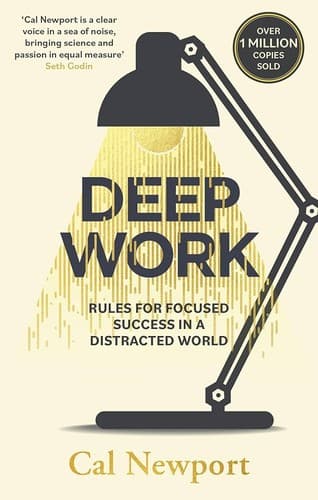
Modular books survive it by design – stop mid-page on Show Your Work! and you've lost nothing. But a book with long chapters, a non-linear timeline, or an argument you're meant to hold in your head across 40 pages? It just dies in fragments. The clearest example from my own shelf is Deep Work by Cal Newport. It's my slowest read ever (around 0.4 pages a minute across fifteen sessions) and the reason I can still rattle off Newport's four rules years later is that I read it slowly, taking notes. You can't do that on a packed train. Trying to read Deep Work (or a 1Q84, or anything you'd want a highlighter for) on the train is just bookmarking. Save those for quite reading sessions. Let the commute have the books that were built for it.
Beat the Phone Default
None of this works if the phone wins the first three seconds. And it usually does – the phone is the default, the thing your thumb reaches for before your brain gets a vote.
What broke it was placement, plus something queued and ready. It's the same trick that fixed my reading at home: I moved my phone out of the bedroom and put my iPad mini on the nightstand, so the book became the easiest thing to reach. Do the commute version of that. Phone in the bag pocket, zipped away; ereader or audiobook in the hand pocket, already loaded, one tap from where you left off. Make the book the path of least resistance and you mostly stop having to decide at all. (I went deeper on this in your reading setup matters more than willpower – placement really does beat discipline.)
And the Duolingo lesson holds: what actually carried me wasn't motivation, it was momentum – a streak I didn't want to break. Reading runs on the exact same fuel. The commute is the single highest-leverage window in a working day, which is also why it's the centerpiece of how to fit reading in with a 9-to-5 and a natural anchor for building the habit in the first place.
But I Want to Switch Off, Not Be Productive
Here's the objection I feel the most: the commute is the one slice of the day that's mine, and the last thing I want is to turn it into another productivity task with a tracker bolted on. Totally fair. I'm not telling you to optimize your commute.
But notice what the phone actually does in that window. Forty minutes of doom-scroll leaves you more drained than when you sat down, a little wired, a little hollow. That's not switching off; that's a constant drip of fast little payoffs that quietly wears you out (I also wrote about that in reading is the antidote to brain rot). A novel you're enjoying, or a modular nonfiction you can dip into, is the genuinely better option. The book is the decompression. The point of claiming the commute is to arrive home not already depleted.
Plan a commute-only reading goal
The Reading Goal Planner shows what the commute alone can deliver across a year – set the target, and let the daily windows fill it.
Plan your reading goalThe Easiest Hour to Convert
Of every window in your day, the commute is the easiest one to convert – because it's the only one that costs you nothing. You're not trading sleep for it, or family time, or the gym. It's already gone; the only question is whether it goes to a feed or to a book. This was my realization: this time is free, so I might as well aim it at something that compounds.
Every commute reading session counts – ebook, audiobook, or both at once – and once the streak is visible in ReadingHabit, showing up stops feeling like discipline and starts feeling like momentum. Claim the hour. The books pile up on their own.
Make your commute the best reading hour of your day
ReadingHabit logs every commute session – ebook, audiobook, or both. Watch the books add up. Join the waitlist for early access.